Optical Division
Technology Overview
First Optical Group
Uses wide-angle, ultra-wide-angle, telephoto, macro, or depth sensors to acquire front, upper, lower, left, and right view information.
Second Optical Group
A multi-faceted prism or multiple mirrors divide and guide rear upper, lower, left, and right rays.
Rear-View Reconstruction
The acquired images are integrated into a complete view through matching, boundary correction, 3D reconstruction, and reprojection.
Operation Simulation
This flow shows rear rays being acquired and integrated into a complete view while switching between prism and mirror methods.
Rear Area
Integrated Result
Combines front and side information with divided rear images and outputs the result as a cubemap or panorama.
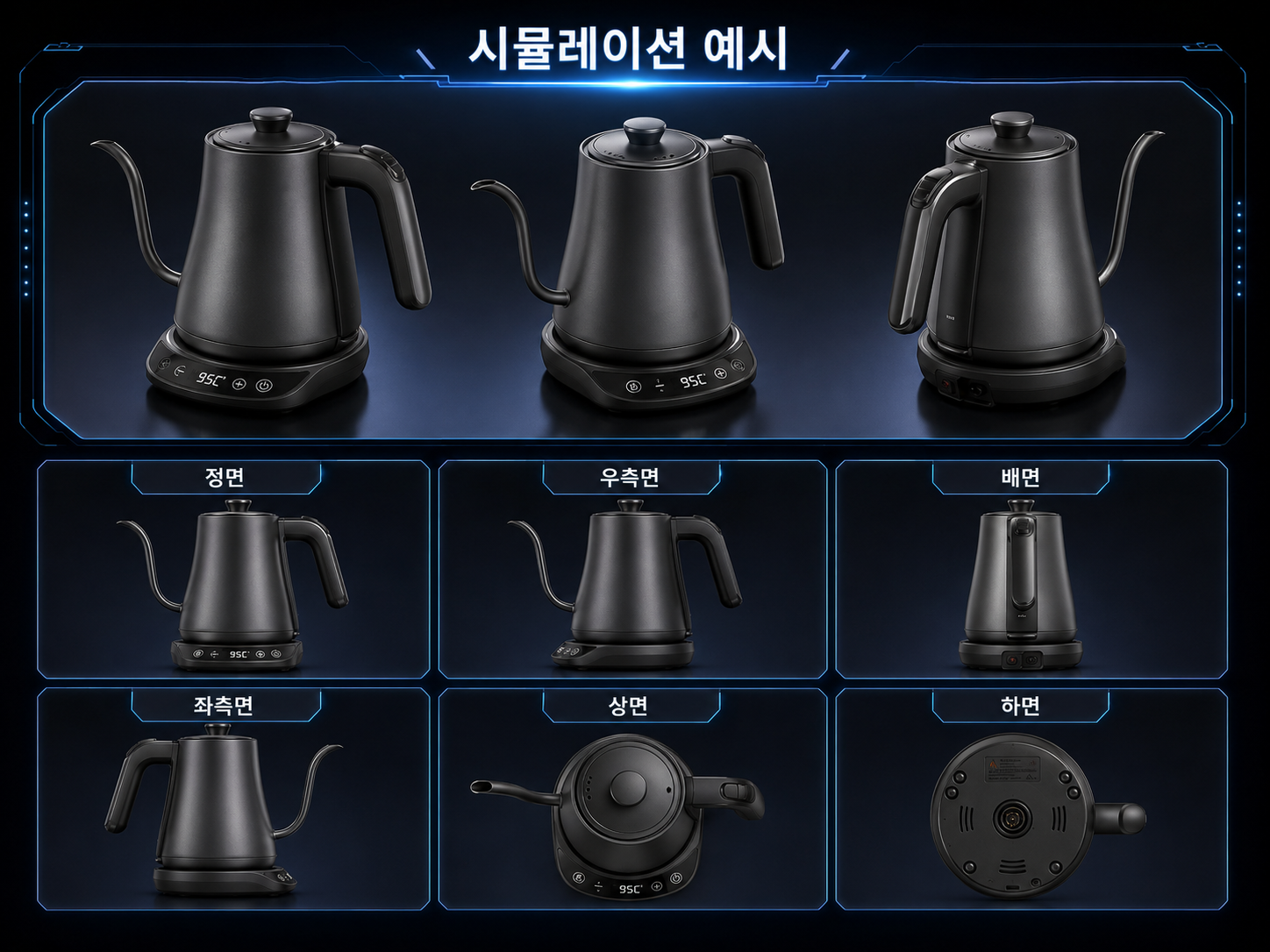
Kettle Example
Optical Structure
Multi-Faceted Prism Method
A multi-faceted prism is placed at the geometric center of four lenses to separately acquire the rear upper, lower, left, and right areas. Because it does not block the front optical axis, spatial efficiency is high.
Multiple-Mirror Method
Upper, lower, left, and right mirrors with different angles are arranged to guide rear rays. There is no chromatic aberration, and reflection angles can be independently designed for each area.
Front-Axis Protection
The second optical group is spaced so that it is not positioned on the front optical axis.
Four-Segment Rear View
The rear upper, lower, left, and right views are separately acquired and integrated.
Video Support
Time synchronization is secured through a global-shutter simultaneous exposure structure.
Software Expansion
Performance can be improved through AP, NPU, GPU, or app updates.
Image Processing Flow
Applicable Fields
Optical Devices
Applied as an auxiliary optical module that secures a full view including front and rear views.
Robot Vision
Supports robots in recognizing objects behind and to the side as well as in front.
Autonomous Driving and Drones
Reduces blind spots of vehicles, drones, and moving bodies and supports multidirectional environmental recognition.
Security Surveillance
Used as a surveillance structure that checks a wide range and rear area simultaneously from a single device.
Medical Imaging
A high-precision mirror-based optical structure can be applied to equipment requiring rear or side observation.
Industrial Inspection
Expanded into inspection devices for areas difficult to view directly, such as the back side, inside, or narrow spaces of products.